

Jewel Loop - Coloring Sort
TaTa Game Technology Limited
I went into Jewel Loop - Coloring Sort expecting a light sorting game, but its appeal is more focused than that. The basic idea is easy to understand: arrange jewels, keep the loop moving, and gradually turn the result into pixel art. What makes it pleasant is the combination of a small organizing puzzle and a visible creative payoff. I am not simply clearing pieces from a board; I am trying to make sensible choices so the finished image looks complete.
That makes it a good fit for short breaks, quiet evenings, or anyone who enjoys casual games with a visual reward. It is free to start, rated for Everyone, and developed by TaTa Game Technology Limited. The store currently shows a 4.8 average from around 9,300 ratings, with more than 100,000 installs, so there is already a sizeable audience for this particular mix of sorting and pixel-art coloring.
How the everyday loop feels in practice
The first sessions are straightforward. I look at the available jewels, sort them into the appropriate places, and spin the loop as the design develops. The controls are approachable enough that I could begin playing without a tutorial-heavy introduction. That simplicity is important because the game works best when I can open it, understand the current task quickly, and make progress without preparing for a long session.
The pixel-art element gives each round a clearer purpose than a conventional matching or sorting board. A move is not only about gaining progress; it also contributes to an image that becomes easier to read as more pieces are handled correctly. I found myself checking the emerging picture after a few decisions, which added a gentle sense of anticipation. The visual result is especially useful for players who lose interest in abstract score chasing.
My usual routine is to begin with the most obvious jewel groups rather than trying to solve everything at once. This reduces visual clutter and makes the remaining choices easier to judge. When the board becomes less crowded, I can spot awkward pieces and decide whether to deal with them immediately or leave them until the next useful rotation. That habit is more reliable than rushing through every available move.
Related News






A realistic use case is a short commute or a waiting-room break. I can play one small stretch, stop when I need to, and return later without needing the same concentration as a strategy game. It also suits a relaxed evening when I want something interactive but not emotionally demanding. I would not choose it when I want a story, competitive matchmaking, or a deep campaign, but that is not what this game is trying to provide.
Why the picture changes the way I sort
The unfinished artwork acts as a useful progress signal. If I am only watching a counter, a mistake can feel abstract. Here, the image gives me a visual reason to stay careful. I can often tell that a section is taking shape, and that encourages me to finish a pattern instead of making random choices.
There is also a small planning advantage in watching the artwork rather than focusing only on the jewels. A nearly complete area can reveal which pieces are still causing confusion. I use that information to prioritize the group that will clarify the image, not necessarily the group that is closest to my finger. This is one of the more satisfying details of the design because it turns the coloring result into part of the decision-making process.
Gallery
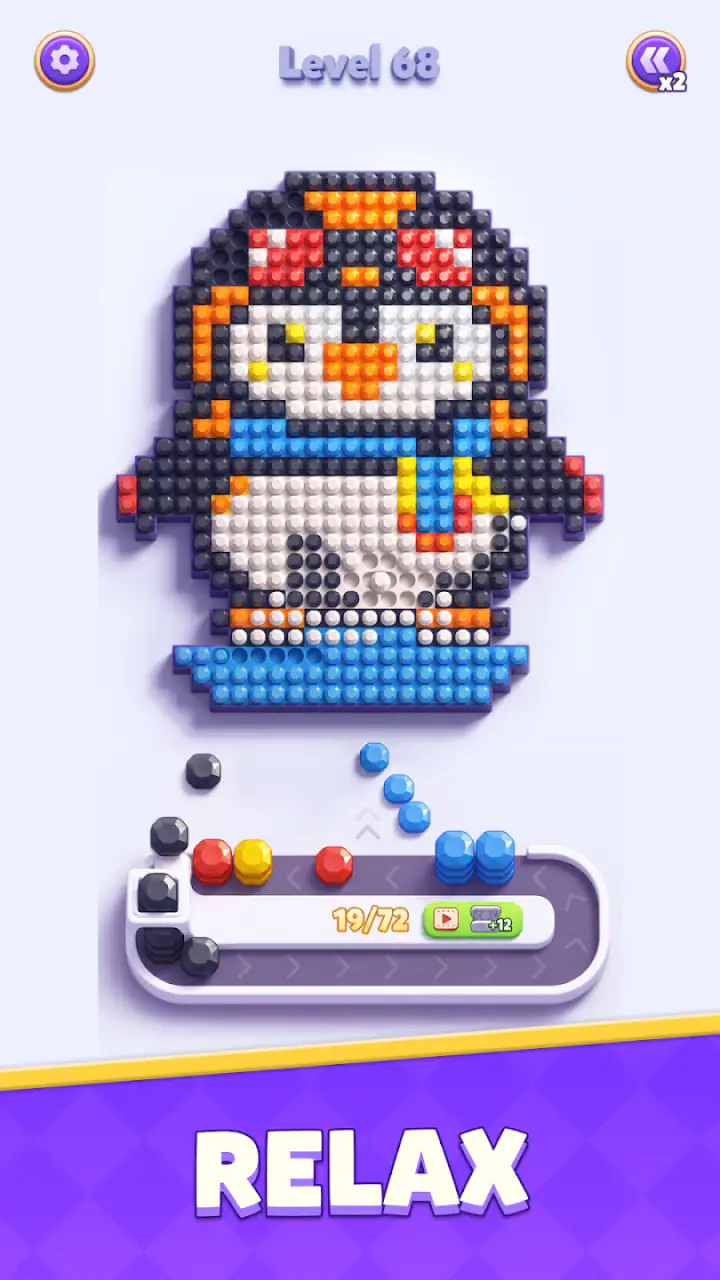
New players should resist the temptation to spin immediately whenever the option appears useful. I get better results by first scanning the whole visible arrangement, identifying the cleanest grouping, and then rotating with a purpose. That extra moment is not difficult, but it prevents the board from becoming messy through hurried actions.
Settings and habits that deserve attention
The game is deliberately uncomplicated, so I would not approach its settings menu expecting a large collection of advanced controls. Still, it is worth checking the available options before settling into longer sessions. I look for the controls that affect comfort, especially anything related to sound, vibration, or the way the board responds to touch. Small adjustments matter when the same basic action is repeated many times.
I also recommend checking whether the current version is behaving comfortably on the device before judging the game too quickly. The listed version is 1.19.1 and the minimum operating system is Android 6.0. That makes compatibility fairly broad for Android users, although the experience can still vary with screen size and touch sensitivity. On a smaller display, I would use deliberate taps and avoid dragging across crowded areas unless the game clearly calls for it.
Because the game is free, I would also review any purchase prompts with care. Optional in-app items range from $1.99 to $99.99 per item. That is a wide span, and it makes it sensible to decide in advance whether I am happy to play entirely at no cost or whether a particular purchase genuinely improves my experience. I would not spend simply to hurry through a board that I am enjoying at a slower pace.
For younger players, the Everyone rating makes the presentation approachable, but I would still explain purchase controls before handing over the device. The visual style is harmless and accessible, yet a child may not naturally distinguish between a normal tap and a payment prompt. A quick conversation about asking before buying is more useful than assuming the rating covers every practical concern.
Repeatable patterns for quicker, cleaner play
After several rounds, I found that speed comes less from tapping rapidly and more from reducing unnecessary decisions. I first separate obvious matches from uncertain ones. Then I work through the obvious groups in a consistent order, usually starting with the area that is easiest to complete or the group that blocks the clearest view of the board. This creates a repeatable rhythm and leaves fewer loose pieces to reconsider.
Another helpful pattern is to pause after a rotation instead of immediately making the next move. The board can look different enough after a spin that my original plan is no longer best. A short visual reset lets me reassess the available jewels and prevents a chain of automatic actions from carrying me away from the artwork I am trying to complete.
I also treat the unfinished picture as a map. When a color or section appears isolated, I use it as a clue about where my attention should go next. This does not turn the game into a complex logic puzzle, but it does make the process more intentional. Players who only sort by proximity may finish less comfortably than players who use the image to organize their priorities.
For a quick session, I suggest choosing one modest objective: complete a visible section, clear a troublesome group, or simply make steady progress without buying anything. That approach keeps the game relaxing. Trying to optimize every move can make a casual title feel like work, especially when the reward is primarily visual rather than competitive.
Where the design starts to show its limits
The same simplicity that makes Jewel Loop approachable can also limit its long-term appeal. If I want increasingly complex rules, strategic depth, or a strong sense of personal control over the artwork, this may feel too narrow. The core loop remains centered on sorting and spinning, so players who need constant mechanical variety may eventually look elsewhere.
It is also not the best choice for someone who dislikes repetition. The satisfaction depends on enjoying small improvements and the gradual completion of pixel art. If that kind of incremental progress does not feel rewarding, the game may seem more like a sequence of similar tasks than a creative activity.
Compared with a traditional match-three game, this title places more emphasis on organizing pieces and watching a picture develop. Compared with a dedicated coloring app, it gives me more interaction and a clearer puzzle-like structure, but less freedom to color every detail exactly as I wish. Compared with a serious puzzle game, it is lighter and easier to enter, though it does not offer the same depth of planning or challenge.
Those comparisons help define the right audience. I would recommend it to someone who wants a calm sorting game with a visible artistic outcome. I would point a competitive player toward a game with leaderboards or head-to-head play instead. I would also suggest a conventional coloring app to anyone whose main goal is unrestricted creative control rather than solving a structured board.
Handling purchases without losing the casual appeal
The free entry point is a genuine advantage because I can understand the loop before deciding whether it belongs on my phone. At the same time, the presence of in-app purchases means I prefer to treat paid items as optional conveniences rather than necessary parts of the experience. The game is most enjoyable for me when I focus on making thoughtful progress instead of measuring every session by how quickly I can unlock or finish something.
My practical advice is to play several sessions first and identify the exact friction I am trying to solve. If I cannot name that problem, I probably do not need the purchase. This is particularly important in a casual game, where slowing down is often part of the reason to play. A purchase that removes every pause could also remove the small decisions that make the sorting satisfying.
Families should be especially clear about who controls purchases on a shared device. The Everyone rating describes the broad suitability of the content, while payment decisions still deserve adult supervision. I appreciate being able to approach the game as a free experience, but I would not leave purchase choices unexplained when another person is using my phone.
Who will get the most from it
I think the strongest audience is made up of players who like visual order, gentle repetition, and small creative rewards. It works well for someone who wants a game that can be understood quickly, but still offers enough decision-making to avoid feeling like a completely passive activity. The pixel-art finish is also a nice touch for people who enjoy seeing a task become a recognizable image.
It is suitable for relaxed solo play and for sharing with a child who can follow simple sorting rules, provided an adult handles purchase boundaries. The Everyone rating supports that approachable presentation. I would still supervise younger users around payment prompts, and I would choose a larger screen when possible so the jewel groups are easier to distinguish.
Experienced players can get more from it by building habits: scan before spinning, complete the clearest groups first, use the emerging image as a guide, and pause after each meaningful change. These are not secret mechanics; they are practical ways to make the existing loop feel less random and more controlled. They also reduce the frustration that comes from reacting to the nearest piece without considering the whole arrangement.
I would skip it if I needed a rich narrative, a demanding brain teaser, open-ended art tools, or a competitive reason to return every day. The game’s strengths are calm accessibility and visual progress, not depth across many genres. Knowing that limitation makes the recommendation more honest and helps avoid expecting a different kind of experience.
My final take after settling into the loop
After spending time with it, I see Jewel Loop - Coloring Sort as a neatly focused casual game rather than an all-purpose puzzle title. The combination of jewel organization, rotation, and pixel-art completion gives ordinary sorting a more tangible reward. I especially like that the picture can guide my attention, turning visual progress into a practical part of play instead of a decoration added afterward.
The best way to approach it is patiently. I would begin with the free experience, check the comfort-related settings, use a repeatable sorting order, and avoid treating every round as a speed test. That method keeps the game pleasant and makes its small decisions easier to appreciate. The broad Android compatibility is convenient, while the current 1.19.1 version gives users a clear point of reference when checking their installation.
My recommendation is positive for casual players who want a low-pressure activity with a creative finish. I would describe it to a friend as a good choice for short breaks and quiet concentration, with enough structure to keep the hands busy and enough visual feedback to make progress feel meaningful. The key trade-off is simple: you gain accessibility and relaxing artwork, but you give up the depth and variety found in more ambitious puzzle games.
For me, that trade-off works. I would keep it available for moments when I want to sort, spin, and gradually reveal something attractive without committing to a long session. Just keep expectations aligned, watch purchase prompts, and use the board deliberately rather than rushing. With that mindset, the game’s modest scope becomes part of its charm instead of a weakness.
FAQs for Jewel Loop - Coloring Sort
What is Jewel Loop - Coloring Sort, and how does the gameplay work?
Jewel Loop - Coloring Sort is a casual puzzle game based on organizing and matching colorful jewel pieces. The main objective is to arrange items in the correct order or group them according to their colors, gradually completing each board. The early levels are simple and help you understand the mechanics, while later puzzles require more careful planning, attention, and strategic moves to avoid running out of useful spaces.
Is Jewel Loop - Coloring Sort free to download and play?
The game can generally be downloaded and played without an upfront purchase, making it accessible to casual players. However, free versions of puzzle games commonly include advertising, optional in-app purchases, or additional features that may require payment. Before downloading, it is worth checking the current store listing for details about advertisements, premium items, remove-ads options, and whether purchases are necessary to progress comfortably.
Does Jewel Loop - Coloring Sort require an internet connection?
Many of the basic sorting puzzles may be playable without a constant internet connection, which is convenient when traveling or using limited mobile data. Nevertheless, an internet connection may still be needed for advertisements, rewards, updates, cloud-related features, or certain events. Offline availability can also vary between versions, so players should test the game after installation rather than assuming every feature works without internet access.
Is Jewel Loop - Coloring Sort suitable for children and all age groups?
The simple color-based mechanics and relaxed puzzle format can make Jewel Loop - Coloring Sort suitable for a broad audience, including players who enjoy short, low-pressure challenges. Parents should still review the age rating, advertising content, privacy information, and available in-app purchases before allowing children to play. If the game displays third-party ads, parental supervision or device purchase restrictions may be advisable.
What are the main advantages and possible drawbacks of playing Jewel Loop - Coloring Sort?
The game’s main strengths are its easy-to-learn controls, colorful presentation, short levels, and gradually increasing difficulty, which make it suitable for quick sessions or relaxing play. It may also help exercise visual attention and basic problem-solving skills. Possible drawbacks include repetitive gameplay after extended sessions, frequent advertisements in the free version, and limited depth for players seeking a more complex or competitive puzzle experience.
Pros
- Relaxing color-sorting gameplay suitable for short sessions.
- Simple controls make it easy for new players to understand.
- Bright jewel visuals give the puzzles an appealing look.
- Gradual challenges help maintain interest without feeling overwhelming.
- Works well for casual play when you have limited time.
Cons
- Some levels may feel repetitive after extended play.
- Difficulty progression can be uneven between stages.
- Frequent ads may interrupt the flow for free players.
- Limited variety in the core sorting mechanics.
- Requires patience when solving more complex arrangements.


